
Parallel parking, step by step
What are the exact steps to parallel park smoothly between two parked cars?
This guide is for teens and adults who want a repeatable way to parallel park on city streets and practice for the road test. It reflects instructor teaching in our Parking Practice program rather than a Nevada DMV scoring sheet.
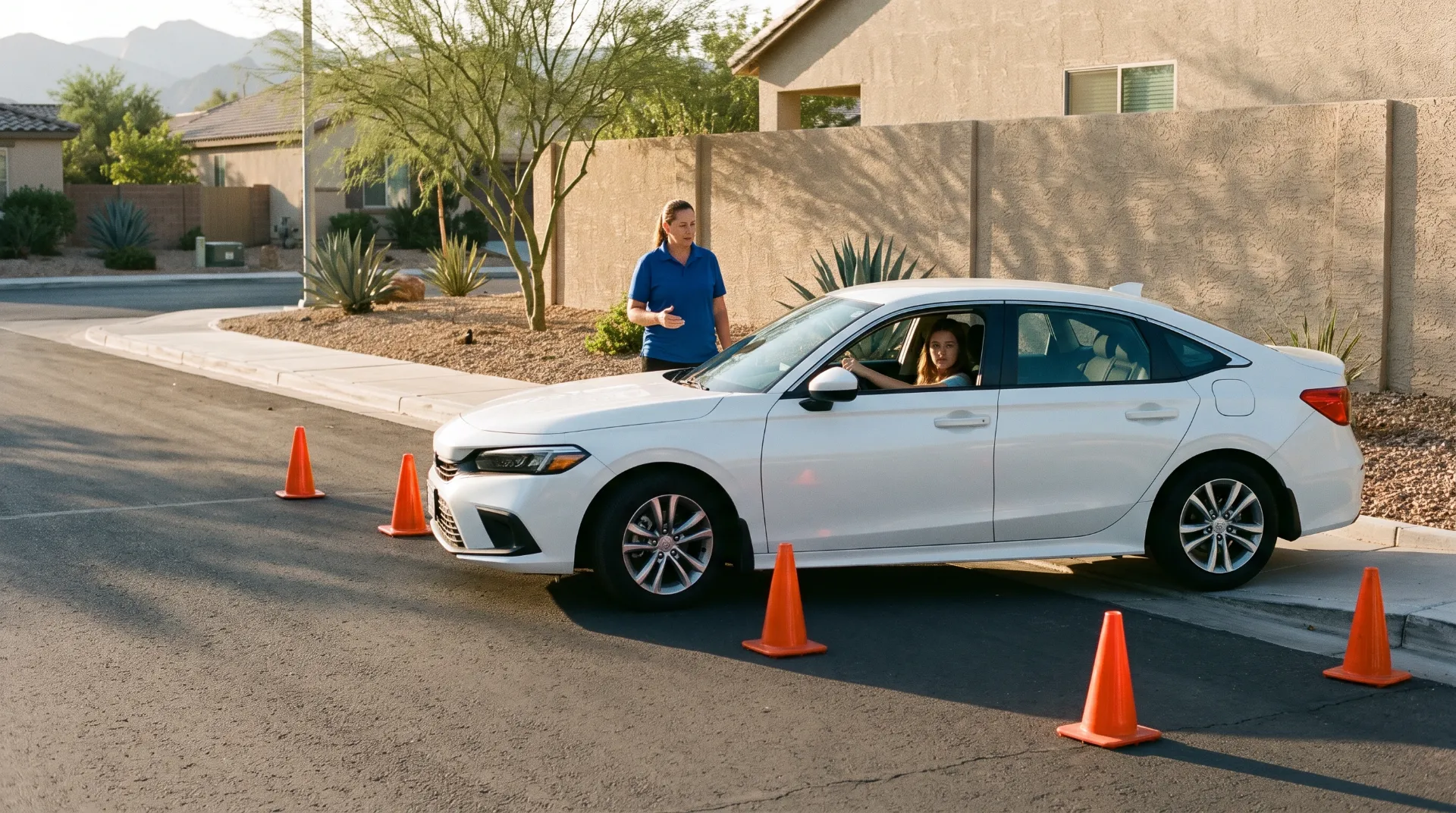
Break parallel parking into 4 clear steps
Parallel parking becomes predictable when you treat it as 4 slow steps instead of one big guess. Pull alongside the front vehicle, back in at an angle, straighten the wheels as you clear its bumper, then steer the other way to align with the curb. Moving slowly gives you time to watch your mirrors and adjust.
Any permit holder or licensed driver can use this sequence in a compact sedan or family car. Exact visual reference points shift slightly depending on the length of the car you drive, so practice in the same type of vehicle you plan to use on test day.
Line up cleanly before you reverse
Step 1 is positioning. Signal toward the curb, check your mirrors and pull parallel to the front car about 2 to 3 feet away, lining up your rear bumper with theirs. Step 2 is the entry angle. Shift into reverse, check all around for cars and pedestrians, turn the wheel all the way toward the curb and back up slowly.
Onramp Parking Practice covers parallel, perpendicular, angle and backing in lots and on streets. Practicing away from heavy traffic at first lets you repeat the alignment until your eyes recognize the starting distance without feeling pressured by cars waiting behind you.
Know when to straighten and swing in
Step 3 is straightening. Once your car sits at about a 45-degree angle and your side mirror lines up near the front car's rear bumper, turn the wheel straight and ease back a few feet. Step 4 is tucking the nose in. Turn the wheel all the way away from the curb and back slowly until you sit parallel, then center the car.
A common error is turning the wheel too early or too late while rolling too hard on the gas. Turning early swings your front bumper close to the front car, while turning late pushes your rear tire into the curb. Keeping your foot covering the brake keeps the pace slow enough to catch either error.
Practice for real streets and the road test
Parallel parking is a useful city skill, and Road-Test Preparation includes a mock test on the maneuvers a DMV examiner grades. This guide cannot say which specific maneuvers a Nevada DMV examiner will score on your appointment, because Onramp does not give the official road test.
Set up 2 cones or empty cardboard boxes in an open lot with a licensed adult beside you if you hold a permit, and check the supervising-driver rules at dmv.nv.gov. Repeat all 4 steps from start to finish, and if you end up too far from the curb, pull out cleanly and reset rather than twisting the wheel in a tight spot.
Slow speed beats guessing every time
Idle speed is your friend during parallel parking. You do not need the gas pedal at all on flat ground. Let the car creep slowly with your foot hovering over the brake, look out the back window as well as your mirrors, and pause whenever you want to check your angle before turning the wheel again.
Build steady parking skills in a lesson
Try the 4 steps in an empty lot first, then move to a quiet street once your angles feel consistent. If you want focused help on parallel, perpendicular, angle and backing maneuvers, Onramp offers Parking Practice and Road-Test Preparation lessons, plus the Test-Day Car package when you have a DMV appointment.
Parallel parking basics at a glance
4 core habits make parallel parking easier to repeat on any street.
- Starting gapPull parallel about 2 to 3 feet from the front parked car.
- 4 stepsAlign, reverse at an angle, straighten, then swing the front in.
- Speed controlUse brake control at idle speed instead of pressing the gas.
- DMV road testExaminers grade maneuvers, and Onramp does not give the official test.
This article is general driving guidance. A Nevada DMV examiner grades maneuvers during the official skills test, and DMV rules can change. Check dmv.nv.gov for current testing rules before your test.
Check rules on the Nevada DMV siteQuestions about parallel parking
Answers to common parking concerns from teens and adult learners.
Do I have to parallel park on the Nevada DMV skills test?
This guide cannot say which specific maneuvers a Nevada DMV examiner will score on your test day. The Nevada DMV runs the official skills test, so check dmv.nv.gov for current testing details.
How many tries does it take to learn parallel parking?
Every student learns at a different pace depending on prior steering control and mirror habits. Consistent repetition in an open lot and on quiet streets helps the steps click without a fixed number of lessons.
What if I tap the curb while backing into a space?
Stop gently, shift into drive, pull forward a few feet while steering away from the curb, and then back in again straighter. Trying to force the rear tire over the curb only makes alignment harder.
What happens in a 2-hour Parking Practice lesson?
Your instructor works one-on-one with you in lots and on streets, covering parallel, perpendicular, angle and backing maneuvers. You finish with a short written summary of what went well and what to practice.
Next steps
Continue building your skills
Find more driving guides, preparation checklists and lesson packages.
Work on parking with an instructor
Try Parking Practice with us. We answer by phone, text or email in one business day, after-hours requests next business day, or call (702) 000-0000.
Call: (702) 000-0000A form request never books or confirms a lesson. The office confirms times by phone, text or email.
This is a demo. What you enter goes to Vegas Website Designs, and we only use it to reply to you.